
Colors of the Moon

Bring «Colors of the Moon» home. Fine art paper, canvas, metal and framed prints, shipped worldwide: buy a print
For books, exhibitions, classrooms or publications: licensing and prices · [email protected]
A gift for Christmas? Order early: production and shipping times are shown at checkout.
On 11 November 2020, this image was published by NASA: APOD
On 15 May 2022, this image was republished by NASA: APOD
In 2023 the image of the 48 Moons was featured in the February issue of National Geographic: read a preview on the National Geographic website
I have collected some of my Full Moon shots taken over the past 10 years. I selected the shades of color the Moon showed to my lens and my eyes.
The atmosphere gives our satellite different colors (scattering), depending on its height above the horizon and on the presence of humidity or suspended dust. The shape of the Moon also changes: low on the horizon, refraction flattens the lunar disk vertically and makes it look like an ellipse. This is one of the reasons why I chose to present my Full Moons in a spiral that ends with a lunar eclipse.

I didn’t notice all the colors that our atmosphere gives to our satellite before starting this work: I did not remember having photographed, for example, a brown Moon (Moons no. 29-30), or that the pink Moon (Moon no. 2) was such an incandescent pink. Only by putting the “brown” Moon next to the yellow one did I realize how brown the brown was and how yellow the yellow was.
It is incredible how little it takes to deceive the human eye. Gianni Sarcone, an expert in optical illusions, explains that this effect is called “simultaneous contrast of clarity”. Even the pink Moon, seen against its own sky, did not look so pink; placed next to the other Moons, in the vortex of duller colors, it seems to light up.
How can the Moon have all these colors?
It is not the Moon that changes color: it is the layers of our atmosphere that give it different colors, depending on their composition (volcanic dust, thin layers of cloud, pollution…). Above all, it is the lower atmosphere that produces the widest range of colors.
It is in the lower atmosphere that dust settles and, depending on the size of the particles, scattering spreads some colors of the spectrum and lets others through.
Another important factor is the slant of the rays crossing the atmosphere when the Moon or the Sun is low.
Low on the horizon, the Moon, the Sun and the other celestial bodies are more visibly affected by scattering, which turns white light into shades ranging from red to yellow.
In the last 10 years I have had various camera models, so the Moons were not all taken with the same instrument, and the shooting settings have always been different: the comparison is therefore not perfectly faithful. Even so, the differences are only a matter of a few shades.
All the Moons have been processed (with Photoshop) over time, but without emphasizing the color, and no filter was ever used: I love atmospheric optical phenomena and I try, as far as possible, to stick strictly to what I see. For this work I did not rework the images: I just cut the Moons out of the original pictures.
Below is the image with the Moons numbered. When I receive requests for more information about individual Moons, I update this page with the original image and related details.

Moon n° 2
When does the Moon appear pink?
The answer lies in the Full Moon of 31 July 2021, which rose with a particularity that can explain when and why the Moon takes on this unusual color:
-

- Colors of the Moon in 40 minutes
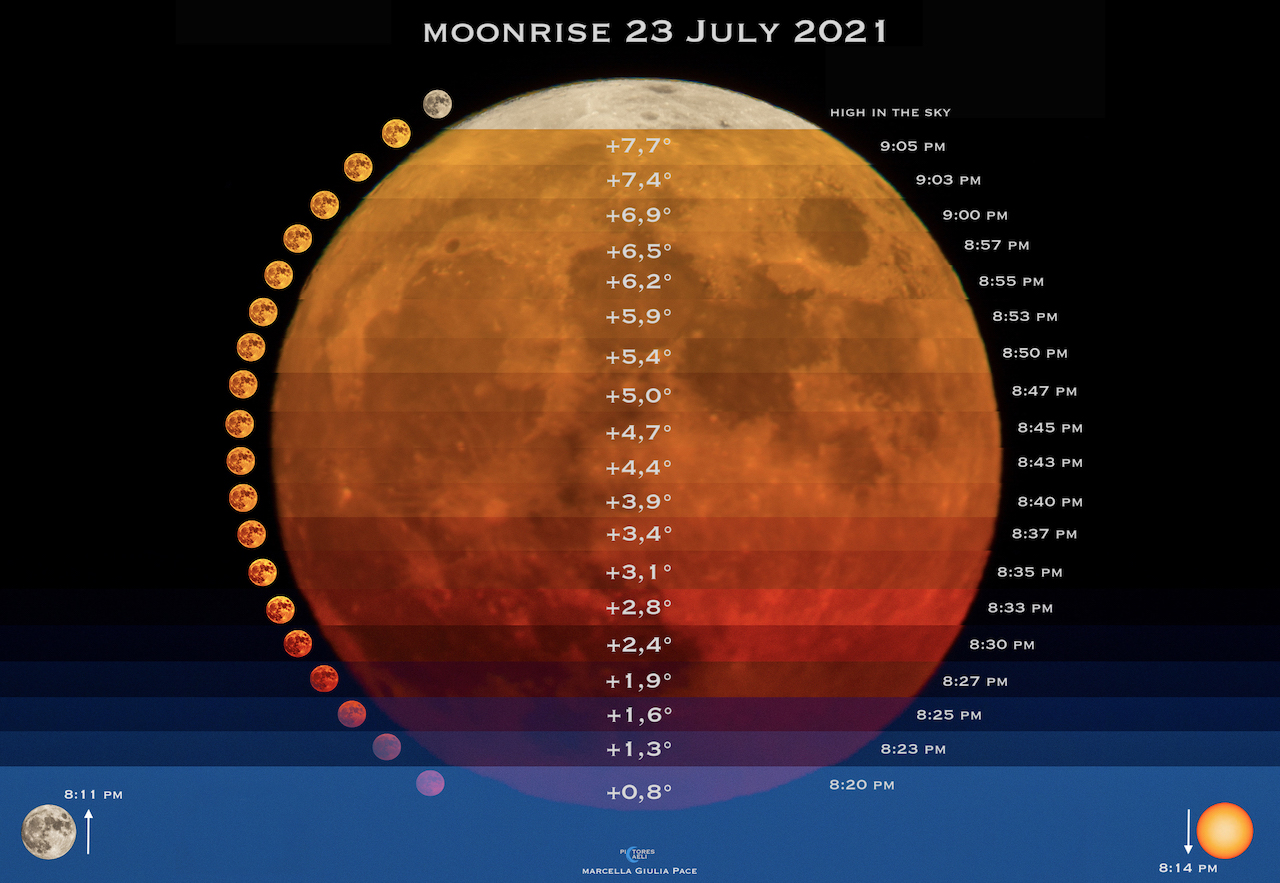
The pink Moon in the spiral composition is the one of 12 March 2017.
-

- 12 March 2017

This Moon had the particularity of rising, at my latitude, at the same moment the Sun was setting: the Sun set at 6:06 PM at 267° W and the Moon rose at 6:06 PM at 85° E. A very narrow handover: since refraction delays setting and advances rising by a few seconds, both bodies were close to the horizon at the same moment. A truly unique condition.
To capture this event, I chose a location open to the sea horizon from east to west: Isola delle Correnti (Syracuse), 36°38’54.6″N 15°04’48.8″E.
-

- 09/03/20 ore 18:00 Full Moon Moon Day: 15.06 Illumination: 99,8%

The reason why it takes on this color could also be linked to backscattering: the Belt of Venus.
https://greenflash.photo/greenflash-gallery/greenflash-gallery/portfolio/belt-of-venus/
Other photographers have also captured the Moon with this particular color:
Space.com: supermoon 2013 photos
Moon n° 48
Lunar eclipse: the Earth’s shadow does not make the Moon completely dark. It still lights it with this red glow, because the Sun’s rays cross the layers of our atmosphere and are projected onto the Moon.
https://greenflash.photo/greenflash-gallery/greenflash-gallery/portfolio/eclipse/
And the Sun?
-

- Colors of the Sun

https://greenflash.photo/greenflash-gallery/greenflash-gallery/portfolio/colors-of-the-sun/
Sun and Moon In Infinity
-

- Colors of the Moon

-

- Colors of the Sun

-

- Evolution
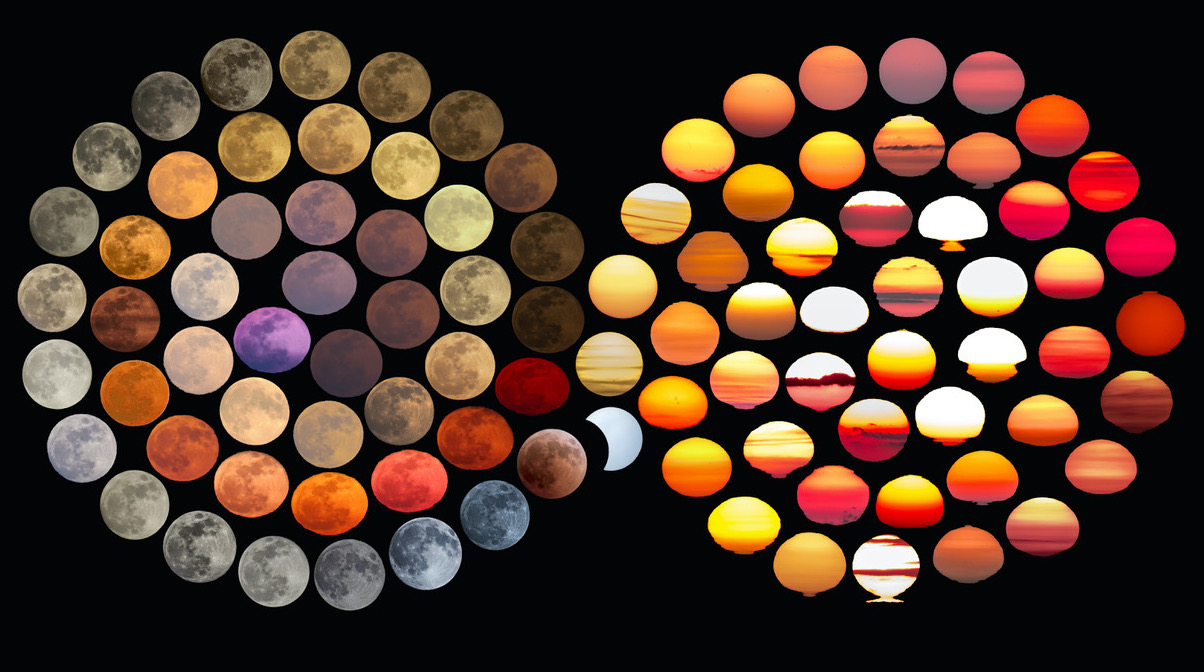
This image is my personal synthesis of my fascination with the idea of infinity inspired by the spiral.
The composition is made of photographs (natural, unretouched) taken over ten years and joined into two spirals: one made of 48 Full Moons and another made of 48 Suns, linked by a Moon in eclipse (2018) and a Sun in eclipse (2015), to create an endless movement.
I chose a double spiral because the spiral is linked to the ideas of emanation, extension and development: in particular, to the idea of a cyclical yet progressive continuity, and of creation, expressed by the sense of rotation.
I wanted to make visible, and extend to infinity, the apparently circular movement of the two bodies, finding in mathematics an undeniable point of agreement between spiritual positions that are often different and that have always needed, but never as urgently as today, to be reconciled. The spiral is a geometric figure found in every culture: a line that winds around itself.
Already in the caves used in the Palaeolithic the meaning of the spiral is fully expressed: it is associated with images of crescent Moons, or of animals with crescent-shaped horns, always linked to the cyclical rhythms of life and close to symbols of energy and fertility, tied to water and to the Moon itself.
In many cultures it represented the journey after death and the ascending and descending cycle linked to the phases of the Moon, as many Neolithic artefacts show: a symbol of time-keeping and regeneration, of movement and energy.
Among the many forms a spiral can take, I chose the flat spiral because it starts from the centre and develops outwards. I wanted to express evolution, development, syntropy, but also the joining with the other spiral, which returns from the outside to the centre, touching, like two raised index fingers brushing against each other, involution, envelopment, entropy. I liked the idea that the two spirals would look like a labyrinth, intelligible and natural, but still a labyrinth: one representing the infinity of the perpetual movement of becoming, the other the infinite eternal return of an initiatory journey, closed to the unqualified; an unveiled mandala leading the observer towards a centre hidden only from those who do not truly want to observe. We always observe too little when we look. That is why I wanted the infinity of these two spirals to recall the cycles of life not only in the macro (the shape of some galaxies, including the Milky Way, is a spiral) but also in the micro, and in the natural world constantly before our eyes, which are often too distracted to recognise (or have forgotten) the spiral growth of a shell, the horns of a ram, the tusks of an elephant, the flower head of a sunflower, the circling of a bird of prey above its quarry, the vortices of hurricanes.
This is why, for me, this image carries a message of respect, attention and love for every form of life. At the root of any civil and peaceful coexistence there must be the awareness that our neighbour is not only our fellow human being, but every form that life takes as it perpetuates itself, living, dying and being reborn, to die and be reborn again, on an eternal path whose course is not a circle with man at its centre but a spiral of life. Constantly evolving.
OTHER FREQUENTLY ASKED QUESTIONS
What color is the Moon?
Looking at the Full Moon from our planet, high above the horizon and very bright, we have the impression that it reflects much of the sunlight. In fact the Full Moon has a very low albedo: it reflects about 7% of the sunlight, and its dominant color is not white but something very close to slate grey. It looks so bright because we have nothing to compare it with, except the stars and the dark sky.
Why do some Moons look oval?
As it approaches the horizon (from about 0.4° above it), the Moon, like the Sun, begins to deform: more precisely, its upper and lower limbs are flattened, as shown in the video below. This deformation is caused by refraction, which acts in all the layers of the atmosphere down to the layer next to the ground.
https://greenflash.photo/greenflash-gallery/greenflash-gallery/portfolio/moon-mirage/
Were all the Moons taken from the same place?
They were not taken from the same position but in different places in Italy where I have lived over the years. The Moon was also photographed at different heights above the horizon: the most flattened are the Moons that had just risen, made oval by refraction.
Is there some sort of time order to the images?
The Moons are ordered by gradation of color shades, not by date.
Is there a meaning to the spiral pattern?
When I cut out all the Moons and put them together, I immediately thought of a spiral, paying attention above all to aesthetics and harmony.
I live in a part of Sicily where there are plenty of traces of Neolithic populations, and the spiral is depicted very often. I am fascinated by the ascending and descending cyclical movement shown by the spiral, comparable to the phases of the Moon: the symbol of the spiral was associated with the crescent Moon, as can be seen in many Neolithic artifacts.
While I was composing the image, an astrophysicist friend of mine, Salvo Pluchino, also pointed out that the spiral recalls the spiraling path the Moon has followed over the last 4 billion years, moving from about 30,000 km from the Earth to today’s average of about 380,000 km.
My thanks to Fisica-Mente Aula Studio for analysing the image.
Where can I buy a print?
The simplest way is Fine Art America: fine art paper, canvas, metal and framed prints in many sizes, shipped worldwide.
Custom prints, in support of nature and animals
If you need a size or a finish that Fine Art America does not offer, you can order a custom print from Nonsolografica, a photographic studio in Ragusa, Sicily.
For these prints I ask for one thing in return: before ordering, make a donation to an association that protects nature or animals, for example WWF, LAV or L214. You choose both the association and the amount.
You pay Nonsolografica only for printing and shipping, and you donate directly to the association: I receive nothing from these prints.
To order, write to Nonsolografica at [email protected], attaching the receipt of your donation.
I have not spoken about this publicly before, but supporting nature and animals also means saying so: I hope it helps more people discover these associations.
PRESS
ITALY
Foto del Giorno della Nasa: lo scatto è della siciliana Marcella Giulia Pace
https://www.radiomontecarlo.net
https://eccellenzemeridionali.it
FRANCE
https://zimonews.com/%F0%9F%94%A5-les-couleurs-de-la-lune-credits-marcella-giulia-pace-%F0%9F%94%A5/
SPAIN
https://www.muyinteresante.com.mx
GREECE
UKRAINE
VIETNAM
KOREA
TURKEY
IRAN
HUNGARY
BULGARIA
EGYPT
BRAZIL
INDIA
USA AND INTERNATIONAL
Photographer Spends 10 Years Capturing 48 Stunning Colors of the Moon
http://bharatkalyan97.blogspot.com
JAPAN


crystal Jean Jackson
How can I get a print of this colors of the moon image
Marcella Giulia Pace
Hi William,
thank you so much for your interest in my pictures!
You can find many different sizes here:
https://fineartamerica.com/art/marcella+giulia+pace
Sincerely
Marcella
Toma
Hello, it’s a good work ! Do you sell this image in good resolution ?
Thank’s
Toma
Pamela Calderón
Congratulations on your beautiful work.
Im interested in the piece “colors of the moon” and wanted to know what kind of presentation you find more appropriate for it according to the asthetic you vision for that piece.
Thank you,
Pamela
Mina Petkova
Dear Marcella, your photography is amazing and so is this article. Thank you for taking the time to put beautiful images into context, for your inspired work and for your tenacity to capture what must be hard to capture well. I am about to order some prints and other items for presents, looking forward to holding them and displaying them!
Best,
Mina
amelialouise
Marcella, these are such beautiful captures and I love that this project spans a decade. The creativity in your final image is wonderful, too! I was inspired to create a dataset based on the colors of these 48 different moons (selecting pixels near the Albategnius crater). You can check out the dataset here -> https://github.com/amelialouise/mooncolors I sourced you and this blogpost in the R package’s README and main documentation.
Marcella Giulia Pace
Wonderful! Thanks! Big Surprise! Beautiful work! :-O
Rafael
Mozzafiato, grazie per condividere la vostra passione.
Marcella Giulia Pace
Grazie a te per trasmettermi il tuo gradimento 😀
Erwan RAULT
Ciao Marcella,
amazing work!
I was looki g for buying one of you picture but it seems your name does not appear on it…can you confirm?
Thanks,
Erwan.
Marcella Giulia Pace
Hi Erwan!
Thanks for your interest in my pictures.
The picture “Colors of the Moon” is on sale only through Fine Art America, the only authorized seller.
https://fineartamerica.com/featured/colors-of-the-moon-marcella-giulia-pace.html
Have you found my picture for sale elsewhere? If so, would you mind sending me the link?
Thanks again.
Marcella
Luisa Lopes
Hello,
I’m a moon enthusiastic and I loved your art! I was thinking of tattooing it into my arm one day but I needed your approval because of the copyrights! What do you think about it?
Marcella Giulia Pace
Thanks :-D. Yes, You can.
Marcella Giulia Pace
Update, November 2026: Fine Art America is still the main place to buy a print. For sizes or finishes it does not offer, you can now also order a custom print from Nonsolografica in Ragusa, in support of nature and animals: see “Where can I buy a print?” above.
Luisa Lopes
Marcella, congratulations on your picture! It is amazing..
I loved it the moment I saw it
I am thinking about tattooing something inspired in it, I wonder if you would let me!
Thank you!!
Maci
Hi, I’m a daycare teacher that teaches 1 1/2 to 2 1/2 year olds. I would love a poster for my room. Nothing framed just a poster. How would I get one?
Marcella Giulia Pace
Hi Maci,
thank you so much for your interest in my pictures!
You can find many different sizes here:
https://fineartamerica.com/art/marcella+giulia+pace
Sincerely
Marcella 😀
Bassam Abdul-Baki
Hi,
Love your Colors of the Moon mosaic. I notice that for some of the moons, the rabbit was rotated at different angles. Was that due to camera or editing reasons or because of different geographic locations?
Thanks,
Bassam Abdul-Baki
Jamie Berger
Hello from the US (Seattle)! I am fascinated by the moon and saw your portfolio recently on ModernMet.com. You do such great work!
Do you have the individual moon pictures to explore one at a time (like the individual sun pictures)?
Jamie
Jamie Berger
Hello! I just saw your work featured on Modernmet.com, and wow! I’m a big fan of your work on the sun and moon; is there a way to access each individual moon picture?
Purnima
Hi Marcella,
These are fantastic!!! Congratulations! Am going to looking up the link to buy a print.
My best,
Purnima (which means day or night of the full moon. 🙂
Lisandro Vitor
Amei as dicas. Parabéns pelo site. Aquele abraço!
jeremy
For the purple moon, the explanation could be that the moon was “normally” red, but considering the time and direction of the photo, it would coincide with forest fires in Sicily at that time (see NASA site on forest fires), which could normally result in a bluish moon. The combination of the two, low on the horizon, could explain the purple.
Edward Fredrick
Hi Marcella! I love this image – may I use it in for a TedX talk at my high school (I’m a teacher)? I would put a full citation on the slideshow. I found this image through a National Geographic article. Either way – I’ll be purchasing a print for my classroom as well. The title of my talk is “My moon is purple.”